1982 Kawasaki KZ1000R ELR: The Eddie Lawson Replica.

The Eddie rep remains larger than life.

Necessity, they say, is the mother of invention. All of which explains the appearance of a certain lime-green production motorcycle in the latter part of 1981 that looked a lot like the racebike Eddie Lawson had ridden to that year's AMA Superbike championship. Today, you'd think this was a well-considered plan baked up by the marketing department to "leverage synergies" or otherwise put the racing budget to good use.

In 1981, not so much.

"We had a lot of standard KZ1000Js sitting around," remembers longtime Kawasaki man Mike Vaughan, who'd been called to a meeting to discuss the less-than-stellar J-model sales situation. "Dealers weren't ordering many. Our updated KZ1000J was a good motorcycle but really just a beefed-up Z1, and things were moving on technologically."

That’s an understatement for sure. This was the early ’80s, and things were changing. New technology was on the way, and everyone knew it. What’s more, the dollar/yen situation was in major flux; prices were up and dealers were jammed with marked-down “non-currents” from ’79 and ’80, remainders from the infamous Honda/Yamaha sales war of that period. It was an unsettled time. Enthusiasts knew that we were about to take the leap from traditional air-cooled inline-fours in steel-tube frames to truly groundbreaking machines. Those who loved the old air-cooled fours housed in steel-tube frames already had their fill, and the youngsters were happy to wait for the new metal to arrive.


These cultural and economic challenges blunted sales of the new-for-’81 KZ1000J. “Eddie had just won the ’81 Superbike championship,” Vaughan recalls, “so I asked, sorta off the cuff, why not build a Lawson replica to generate excitement for the KZ line? This sort of thing had been done successfully in the snowmobile industry and with the IROC Camaros. We’d paint the new bike green, just like the racer, give it some special parts, and see how it did.”

Building such a bike wouldn’t be complicated, and the idea gained immediate traction within Kawasaki Motors in the US and, very quickly, in Japan. Kawasaki engineers had two bikes to borrow from when assembling what would become the KZ1000R (or the ELR as it’s commonly known today): the aforementioned J-model and the then-new GPz1100. They also had the very machine Rob Muzzy had built for Lawson, which was crated and shipped to Japan immediately after the final race of the ’81 season. From this they’d build the limited-edition KZ1000R-S1 production racer, of which only 30 were assembled. Little of Lawson’s racer made it onto the production replica, but it was a hell of a visual template to recreate for production.

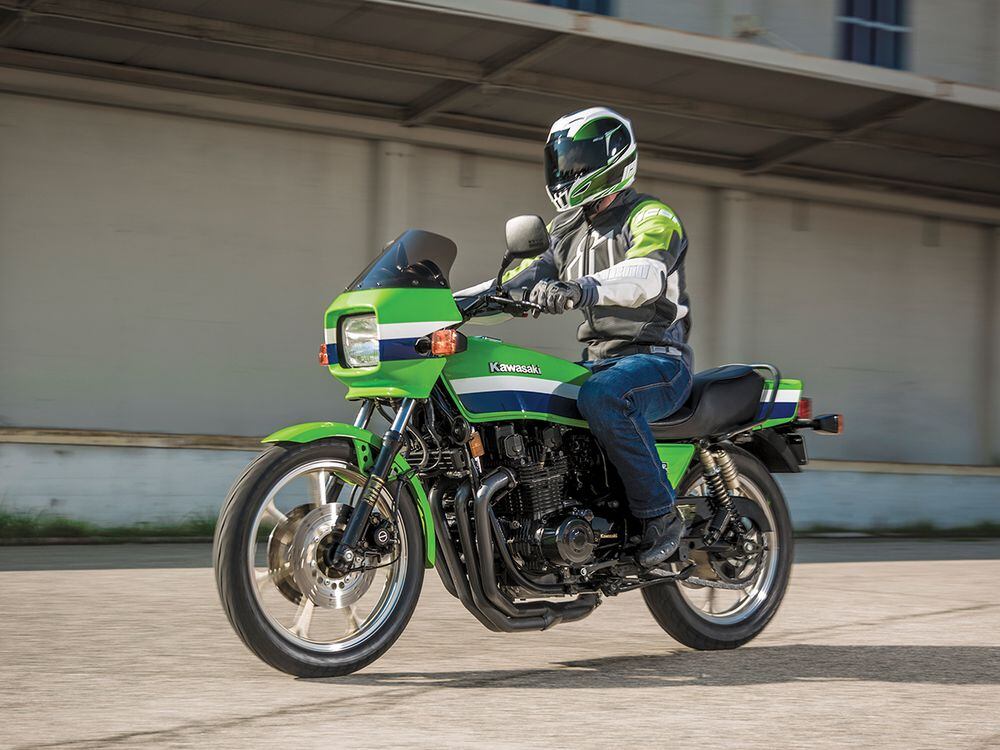
THROWBACK – The lime-green livery, black Kerker, dished saddle, and distinctive striping can mean only one thing: ELR in the house! The KZ1000R of '82 wasn't nearly as fierce as the racebike Steady Eddie used to win a pair of back-to-back superbike titles, but it has become the Japanese collectible in the past two decades.

The 1981 superbike season was something worth celebrating, with Lawson taking the AMA title by just 10 points—with a total of 125—over an up-and-coming racer named Freddie Spencer on a CB900F-based Honda and the famously mop-topped Wes Cooley on a GS1000 Suzuki. Eddie won half of the eight AMA Superbike races that year, Freddie won three, and while he only won once, a consistent Cooley failed to make the podium only for the Pocono round in August.


Building the KZ1000R followed Kawasaki’s typically deliberate path. From the J-model came its 998cc, DOHC, two-valve, air-cooled four, with electronic ignition and strong roller-bearing crank assembly. It was a hammer of an engine, really, and the perfect starting point for hot-rodders already in love with the bulletproof Kawasaki fours. The conventional steel-tube frame was J-spec, too, with slightly lazier steering geometry and additional trail for the presumed higher-speed work the bike would see.

The ELR’s more memorable parts—the long, coffin-esque tank, swoopy tailpiece, and sporty cockpit fairing—came from the GPz1100, as did instruments, brakes, wheels, and its Dunlop K300s. Also added was a deep-dish saddle, more rear-set footpegs and controls, an oil cooler, a black Kerker 4-into-1 (which, by law, had to be installed by the dealer after the bike was uncrated), and a superbike-bend handlebar designed by Lawson himself. It was an impressive piece, visually and technically, with strong, near-GPz performance, reliability, and more than its share of chutzpah that took riders back to the famous Z-1.

But would it sell? Or help sell standard KZs? “It looked great and sparked interest among the press, dealers, and enthusiasts,” Vaughan remembers, “but it didn’t sell all that well. We only built 750 or so that first year, and due to the low production we left pricing to the dealer’s discretion; many priced it too high, and by the time prices dropped, late in the year, the market had changed.”


Boy had it ever. Honda’s new-think, liquid-cooled V-4 Sabre had debuted for the 1982 model year, and the legendary ’83 Interceptor had already been announced. Suddenly, liquid-cooling, perimeter frames, 16-inch front wheels, and single shock rear suspension were at the top of everyone’s two-wheeled wish list. Suzuki redefined the shape of the otherwise conventional superbike with the immediately controversial, Hans Muth-penned GS1000S Katana. Development, for a decade taken at a leisurely pace, was stuck at full throttle. Leftover ELRs would soon face not just the Interceptor but also the Ninja 900R (in 1984), the 20-valve FZ750 (in ’85), and the all-conquering GSX-R (also in ’85). By the time ELR asking prices got within earshot of demand, there really was no going back to air-cooling, twin shocks, and standard-tube frames, at least with regard to performance motorcycles.

From 30-plus years of hindsight, and knowing the extreme collector-itis that’s developed among a certain segment for the ELR over the past 15 or 20 years (not to mention the ungodly prices they command now), it’s simply unbelievable to think that these bikes sat in showrooms unsold for—in some cases—a year or more. “I couldn’t sell the thing,” one dealer confessed. “It just sat. People looked, but they all wanted the latest, greatest thing. It’s funny now to look back on it.” Not only was the ELR experiment a failure, but it didn’t do much to move the plain-Jane J-model, either.

Lawson took the Superbike title once again in ’82, winning five of 11 races and beating the Team Honda juggernaut, and teammate Wayne Rainey rode one of the S1s to third in the title chase. But with the ELRs lingering in showrooms and not creating much of a buzz, those on-track successes were the extent of any Team Green/pro-KZ1000J promotion.


Early in ’82, Kawasaki gave Lawson a crate-fresh KZ1000R, VIN 001. That bike would become hugely collectable down the road and become the subject of some controversy and intrigue. But Lawson asked instead for VIN 021 to highlight his racing number. He owns it to this day, and it’s the bike Lawson is pictured with in this story. Did Lawson have any input on the streetbike? “Nope,” he says with a laugh. “They showed me a couple of pre-production machines early on and asked which paint/stripe scheme I liked. They used the other one!”

Lawson was offered a massive sum for that #021 ELR several years ago by a Japanese investor but turned it down. “I can’t believe I said no,” he says. “The guy offered me a million bucks! What I wish I had was one of the S1s… They were pretty much like my racers but better finished. All my racebikes were crushed,” a fact that Rob Muzzy confirms, as he did all the crushing per Kawasaki’s request. Muzzy, by the way, also owns an ’82 ELR. “It’s VIN 300-something,” he says. “I ride it once in a while, and it’s fun—a great, old-fashioned superbike. Can you imagine building a streetbike like this today, with trick parts and an aftermarket exhaust? Not possible! The lawyers would have conniptions!”

For 1983, Kawasaki soldiered on, keeping the ELR in the lineup, now called the Superbike Replica in light of Lawson’s departure to Yamaha’s GP team. The erstwhile ELR received several changes. These included GPz-spec cams, valves, and cylinder head, adjustable shock damping, new instruments, a slightly longer swingarm, and revised graphics with a different tank sticker. Despite making more power, the ’83 KZ1000R seemed even more lost than the ’82 machine; Superbike racing had moved to 750s and Kawasaki campaigned a lime-green GPz750. It would be years before ELR’s mystique would begin to grow…

But not that many years. Vintage Superbike collector Brian O’Shea, who owns a handful of pedigreed and championship-winning Superbikes, says interest in the ELR began to bubble in the late 1980s. “It got crazy real quick,” O’Shea says, “especially with the S1s, as it was an actual and competitive Superbike racer you could buy from a manufacturer. The ELR craze hit in about ’89, with Japanese exporters running ads in Cycle News wanting ’82–’83 ELRs for top dollar. I paid $1,500 for my first two ELRs around the same time and sold them to exporters for nearly $6,000 each a few months later. And since Eddie and Freddie were like gods in Japan, ELRs got really desirable.”

Desirable might be the understatement of the year. “They’re just so cool looking,” O’Shea says, “and they bring you back to the early 1980s immediately. It’s not so much the bike but the time-machine aspect of it.” Time machine. O’Shea’s analogy is spot on, for it captures many of the reasons certain motorcycles transport us back to an earlier time—in this case, a time of wobbly, fire-breathing Superbikes, with guys named Lawson, Spencer, Cooley, and Baldwin fighting it out on the racetracks of legend…Pocono, Laguna, Daytona, and Loudon.

Time and technology marched on, relegating the old tube-frame, air-cooled fours to curiosities, then museum pieces, and then templates for modern retro. Today, an ELR—a real one like Lawson’s or even one of the many clones cobbled together from KZ1000Js and GPzs—is a period piece. A handsome, slow-turning, slow-revving, not-really-all-that-fast Universal Japanese Motorcycle with a cool paint job. But for enthusiasts who watched these dinosaurs race, the sight of an original, blinding-green ELR is a nonstop ticket to their fondly remembered and almost certainly aggrandized youth. Underwritten by a perfectly nice KZ1000J that just didn’t sell. Thanks, necessity; we owe you one.
The Ride of a Lifetime

Riding Eddie’s ELR—and getting to hang out with the four-time world champion in his garage—ranks up there as one of the most extraordinary things I’ve done.

Eddie seemed to have no reservations about handing me the keys to his ELR, which I rode away from his Upland, California, house on a perfect SoCal morning. The KZ1000R is a large bike, close in stature to one of today’s bigger-boned nakeds, but without the stiff frame, good brakes, and sticky tires. “The bikes flexed and slid and were hard to ride,” recalls Eddie, “but we didn’t know any better.”

I knew better than to do anything but be supremely cautious with the bike, which is easily the most valuable machine I've ever ridden. But the monetary value isn't what made my ride on the ELR exceptional—it's the bike's significance and who it belongs to that made the seat time so special. Thanks, Eddie. —Ari Henning

THROWBACK – The lime-green livery, black Kerker, dished saddle, and distinctive striping can mean only one thing: ELR in the house! The KZ1000R of '82 wasn't nearly as fierce as the racebike Steady Eddie used to win a pair of back-to-back superbike titles, but it has become the Japanese collectible in the past two decades.


Eddie Ray Lawson.


 Eddie Ray Lawson was raised on the dusty dirt tracks of California in the mid-1970s and began road racing

in the late-70s, at first of 250 Grand Prix bikes, then later on Superbikes.


Lawson seemed destine for greatness from the very beginning, In his first AMA Superbike finish he won at

Talladega in 1980. In only his second full year of Superbike racing, 1981, Lawson won the title in a close

battle with rivals Freddie Spencer and Wes Cooley. Lawson became known as "Steady Eddie" for his

consistent performances during the course of a season.


Lawson came back to win his second AMA Superbike title by the slim margin of nine points over Honda's

Mike Baldwin. The 1982 season was to be his final full year of racing in America. In 1983 he left to compete

in the 500cc World Championship Grands Prix where he brought home four World Championships.


Eddie Lawson will go down in history as one the greatest motorcycle road racers of all time.

Lawson won the 500cc World Championship four times during the 1980s. When he retired from GP racing

in the early 1990s, he ranked third on the all-time 500cc Grand Prix wins list with 31 victories.


In addition to his international accomplishments, Lawson was equally successful on the domestic front.

The Californian won the AMA Superbike Series twice (1981 and 1982) and the AMA 250 Grand Prix Series in

1980 and 1981. When inducted into the Motorcycle Hall of Fame in 1999, Lawson was the only rider to ever

win the AMA Superbike and 250GP titles during his career. Lawson also won the Daytona 200, the first time

during the prime of his racing career in 1986, then again in 1993 when he returned to the event after

retiring from full-time motorcycle racing.


Lawson was born in Upland, California, on March 11, 1958. He grew up around motorcycles. Both his father

and grandfather raced. Some of Lawson’s earliest memories are of going out to the desert races with his

father. Lawson started riding an 80cc Yamaha when was 7 years old, having to hold the nearly full-sized

bike up on his tiptoes when he came to a stop. By the time he was 12, Lawson was racing the local Southern

California dirt track circuit.


"We rode mainly at tracks like Corona and Ascot. I didn’t do very well for the first couple of years,

" admitted Lawson. "I just sort of rode around cautiously trying to not fall off my little 90cc Kawasaki Green

Streak."

It didn’t take Lawson long to get over his timidity. He quickly became one of the fastest young amateurs

in Southern California during the early 1970s heyday of dirt track competition.

Besides dirt track racing, Lawson also began to hit the local road races after his grandfather bought him a

50cc Italjet. He later graduated to a Yamaha RD350. This road racing experience would later prove to be

very valuable for Lawson.

By 1978, Lawson obtained his AMA expert license. He was riding Shell Thuett Yamahas, which were very fast

for Yamaha dirt trackers, but were no match for the Harley-Davidsons that dominated dirt track racing.

Lawson did manage to do decently on TT tracks. Hisbest finish of his rookie expert season was fifth in the

TT national at Santa Fe Speedway near Chicago.


By 1979, it was becoming clear that Lawson was fighting an uphill battle on the dirt tracks,

while just the opposite was happening at the road races. At 20, Lawson was already considered one of the

top road racers in West Coast club racing. In 1979, he proved that he was a force to be reckoned with

when he finished second to a young Freddie Spencer in the AMA 250 Grand Prix national at Sears

Point Raceway in Sonoma, California. Lawson finished the season as the second-ranked rider behind 

Spencer in the AMA 250 GP series.


While doing a made-for-television Superbikes event late in 1979, Lawson was invited to a Superbike

tryout at Willow Springs Raceway by Kawasaki. Lawson set fast time in the tryout and was offered the ride.

"It was really pretty fun to ride those old 1000cc Superbikes," Lawson recalls. "They were pretty heavy

and had a lot of power and with the wide handlebars you could actually ride them a lot like a flat tracker,

power-sliding out of the corners and everything."


It did not take long for Lawson to get used to racing Superbikes. Lawson won his first Superbike national

at Talladega, Alabama, in April of 1980. That season saw some epic battles between Lawson,

Freddie Spencer and Wes Cooley. The season ended with Cooley winning the title in a controversial manner,

with protests and counter-protests being filed between the Kawasaki and Suzuki Superbike teams.

Cooley had to wait two months after the season to finally be awarded the championship. The same season,

Lawson dominated the AMA 250 Grand Prix Series.

The Superbike controversy at the end of 1980 just made Lawson more determined.

He came back in 1981 and won the title after another great year of battling Honda and its top rider,

Freddie Spencer. The Lawson/Spencer rivalry would go down as one of the best in the history of Superbike

racing. During this period, AMA Superbike racing really came into prominence and

started to replace the Formula One class in importance. Lawson again won the 250GP title in ’81.

Lawson’s ’80 and ’81 hampionships marked the only times that Kawasaki would win the AMA 250

Grand Prix titles.

Lawson's last full season of racing in the U.S. was 1982. Again, Lawson and Kawasaki held off a serious

challenge from Honda, that year with Mike Baldwin, who finished second in the series.

The Kawasaki KZ1000 had been raced in the AMA Superbike class since the first race in March of 1976,

but hadn't won until the fifth race of the 1977 season. Reg Pridmore set the precedent for the domination

of the class by Japanese bikes. Pridmore would go on to win the championship that year and also in '78.

 Until 1980, Kawasaki was content to let others, such as the Vetter and Racecrafters teams,

race their bikes for them. Now they recruited a young rider named Eddie Lawson for a factory backed

Superbike team. Another racer of great promise, Wayne Rainey, would later join the effort.

Rob Muzzy would build and tune the bikes that Eddie Lawson rode to the championship in 1981.

To commemorate the win, Kawasaki built "the most striking, most performance-ready street-legal

Superbike ever. The brand-new 1982 Kawasaki KZ1000R Eddie Lawson Replica.

(Quote from the KZ1000R brochure.)

Based on the standard KZ1000J model, the R1 had the fuel tank, rear-set footpegs, oil cooler and wheels

from the GPZ1100. A GPZ style fairing and lower handlebar were added along with a Kerker KR-series

four-into-one header. Revised steering geometry

and suspension improved the handling. The motor was unchanged. Motorcyclist Magazine got an ET of

11.56 from their test bike in1982.

That may seem slow in comparison to today's 10 second 600's and ZX12's running mid-9's, but it was

quite respectable at the time.

If you had the urge to go even faster on an '82 Kawasaki, you could purchase the KZ1000S1.

This was no replica--this was the real deal. For a mere £8000 a ready-to-race Superbike could be in your

driveway.
At the crankshaft, the motor put out 136 horsepower compared to the 79 of the R1. Eddie Lawson's race

bike was said to have 149 horsepower. Harnessing all this power was a braced swing arm and huge

brakes attached to the Dymag magnesium rims.


The power may have been harnessed, but it certainly wasn't tamed. These motorcycles were being ridden

much faster and harder than their designers intended. The frames would twist and flex from the

horsepower and cornering loads. It was common for the riders to be seen sliding the bikes around the

turns. Rob Muzzy was quoted as saying," those bikes were like dirt-tracking on the pavement.

You really had to muscle them around."


This era was a turning point for Kawasaki, whose racing efforts in the 1970's had limited success.

No longer would this be the case. To this day the green bikes are a force to be reckoned with,

having a heritage of power and reliability.

Article By Kent Kunitsugu.

The Original article was By Kent Kunitsugu, published in the October,1999 issue of Sport Rider.


Back in the days when men were men and sheep were scared, the word "Superbike" meant fire-breathing 1000cc four-cylinder machines-not these namby-pamby 750s they're using today. And riders didn't have the luxury of full fairings and aluminum perimeter frames, either-regular ol' handlebars and a steel-cradle chassis were the norm back then. These four-stroke monsters were on the verge of becoming the premier class in AMA racing, and it was already turning into out-and-out war between the manufacturers. Honda, Kawasaki and Suzuki were crossing swords with high-dollar factory teams and riders like Wes Cooley, Eddie Lawson,Fred Merkel and Freddie Spencer. The competition was intense, reflecting the increasing prestige of the once-disdained class.
But when all was said and done at the end of the season, one bike-and-rider combination stood above the rest: Eddie Lawson and the lime-green Kawasaki. Despite an engine that lacked the latest four-valve technology sported by the competition, Team Green had emerged victorious against considerable odds. In commemoration of its 1981 AMA Superbike championship, Kawasaki built a very limited number of special KZ1000Rs that, although appearing to be nothing more than a tarted-up KZ1000 at first glance, turned out to be a far better performer than the standard J-model, even with a suggested retail price that was listed as "set by dealer."

The biggest improvement was a change in steering geometry and riding position. The rake angle was extended to 29 degrees from the J-model's 27.5-degree spec, with an accompanying increase in trail from 3.89 to 4.50 inches. Generous scalloping to the standard saddle dropped the seat height by half an inch, and the footpegs were set four inches farther back and an inch higher. Suspension was altered, with a revalved (read: stiffer rebound and compression damping) fork and twin gas-charged, piggyback Showa shocks handling the road-hugging chores. A Kerker 4-into-1 exhaust replaced the standard 4-into-2 pipe, with other subtle changes such as a four-row oil cooler, wider rear rim (wow, a 2.50 incher!), an "Eddie Lawson bend" handlebar, some decent Dunlop rubber replacing the usual rim protectors of that era, and various GPz componentry (brake system, fairing, gas tank, etc.) completing the picture. Maybe the most surprising change, however, was the lack of weight. The KZ1000R scaled in a full 41.5 pounds lighter than the J-model.

Of course, it should be kept in mind that this is early '80s technology we're dealing with, so the KZ1000R's performance-while excellent for its time-isn't nearly up to today's standards. The added rake and trail give the R's chassis good stability in the fast stuff, and the steering is fairly neutral all the way down to max lean. But there's a pretty big slab of metal in the engine bay and keeping the motor high to stop the cases from grinding means a fairly tall center of gravity. The suspension on the bike we rode was pretty worn out (22,000 miles were already logged on the odometer) so handling was rather loose and not representative of the actual item. Keep the KZ1000R's year of manufacture in perspective, though, and you find it to be a fun sporting mount with an exclusivity that can't be matched by any Japanese sportbike of that era.

This article was originally published in the October, 1999 issue of Sport Rider.

Original article by the Auto Editors of Consumer Guide.

The 1982 Kawasaki KZ1000R motorcycle was developed in response to the increasing success of a motorcycle racer named Eddie Lawson, who in the early 1980s turned out some impressive lap times with his 250-cc Kawasaki competition bike.

With the creation of the competition Superbike class, Mr. Lawson switched to larger street-based machines, and often put them in the winner's circle.


The 1982 Kawasaki KZ1000R was widely known as
the Eddie Lawson Replica, after a top bike racer.


To commemorate these feats, Kawasaki released the 1982 Kawasaki KZ1000R motorcycle, otherwise known as the Eddie Lawson Replica, or ELR for short.

Based on the standard KZ1000, it sported the same 1015-cc double-overhead-cam inline four, but with a special four-into-one Kerker exhaust header as standard equipment (Kerker enjoying second billing on the fuel tank).

Painted "Kawasaki racing green," the ELR was also fitted with a small bikini fairing that probably did little to protect the rider, but added a competition look -- as did the blacked-out engine.

Stiffer front suspension and special "piggyback" reservoir rear shocks aided road holding, while triple disc brakes brought the whole affair to a halt.

Relatively few KZ1000Rs were built, making them rare when new and even more rare today. But Kawasaki later revived the spirit of the 1982 Kawasaki KZ1000R motorcycle by releasing an updated replica (making it a replica of a replica) called the ZRX1100.

Go on to the next page for more pictures of the 1982 Kawasaki KZ1000R motorcycle.
The 1982 Kawasaki KZ1000R was a fine example of an early-1980s Japanese superbike. "Kerker" on its fuel tank recognized the bike's standard four-into-one Kerker exhaust header.


The Kawasaki KZ1000R wore the company's
distinctive green racing colors.

The KZ1000R's instrument panel was familiar
to Kawasaki fans.

Kawasaki's 1015-cc double-overhead-cam four
revved happily to 9000 rpm.

Suspension of the KZ1000R included gold-painted
"piggyback" reservoir rear shocks.

A decal on the tank reminded riders of Kawasaki's
racing victories.


For more great motorcycle articles and pictures, check out:


Original article intact even though bike pictured is actually a 83 kz1000r2,

kind of funny really!

Moto Retro Illustrated.

Mitch Boehm Editor, Moto Retro Illustrated.

Hi everybody

As many of you know, Motorcyclist Retro was killed by the publisher due to the economy, which is ironic because the magazine did pretty well, selling over 20,000 copies of all three issues we published. Anyway, the success there prompted me to relaunch the magazine under a new name - Moto Retro Illustrated - which we've now done. Issue one is at the printer, and features Eddie Lawson on the cover posing with his personal Lawson Replica KZ1000R. There's a 14-page story inside on the Lawson Replica, Lawson's career, etc. Also plenty of other street and dirt stuff from the late 60s to the early 80s, the era we're concentrating on. BTW, I just bought an '82 GPz750 as part of a GPz story we're working on, and as always, Kawasaki fours will always be part of what we do. So hopefully some of your bikes will end up in our magazine, and there are obviously plenty of historical and tech contacts on this board. Please shoot me a note here or at This email address is being protected from spambots. You need JavaScript enabled to view it. if you have comments, questions, etc.

PS: The cover of issue #1 is attached.


Thanks! Mitch

www.motoretroillustrated.com

preview our latest issue
Click any image on our Table of Contents to preview an article in Issue #1.
Click here to purchase this Back Issue.

rodder spread

another issueIn this issue: Eddie Lawson and the Eddie Lawson Replica • The First Monoshocker • Route 66 Revisited • Passion and Pride • Unadilla 1975 • Bob Hansen and Honda • Hodaka Super Rat • Jeff Ward • Darryl Bassani • Vintage AM Motocross • Yamaha Seca SST • Team Honda 1973 • Project CR480R • Aerostitch Roadcrafter • Moto Bikes of the 70s • Wes Cooley at Daytona, 1981

Click here to purchase this Back Issue.


preview our latest issue
Click any image on our Table of Contents to preview an article in Issue #2.
Click here to purchase this Back Issue.

rodder spread

another issueIn this issue:Kenny Roberts Now • Wild Thing: What happened at the '75 Indy Mile by Kenny Roberts • The 1968 Yamaha DT-1: the bike that broke things wide open • Honda's SL70 mini • Carlsbad Raceway revisited • Full Circle: Same track, same bike, same rider: 1978 and again in 2009 • Kevin Schwantz jumps on the 1993 Suzuki he rode to the 500cc World Championship • Larry Pearson's Cooley-Rep custom GS1000S Suzuki • Win a Sandcast CB750 • Bikes we're restoring, riding & messing with.

Click here to purchase this Back Issue.

preview our latest issue
Click any image on our Table of Contents to preview an article in Issue #3.
Click here to purchase this Back Issue.

rodder spread

another issueIn this issue: Edison Dye's 1968 Inter-AM • Mike Baldwin's 1982 Honda 1025cc Superbike • Marty Moates epic win at the 1980 USGP • A history of the notoriousYamaha TZ750 • Scott Guthrie: Mr. TZ750 • Joel Robert's game changing 1972 Suzuki 250cc Suzuki RH72 • Rupp Roadster, 40 years later • Honda's Goldwing: 35 year Anniversary • Artist Masaki Okamoto • Kawasaki Coyote • The Guggenheim CB750 • The FIrst Honda RC: Before the Elsinore • Carlsbad '78 Contest • Tray Batey's Roach and more.


Click here to purchase this Back Issue.

Copyright © 2026, www.kz1000r.com. All Rights Reserved.